Skip to content
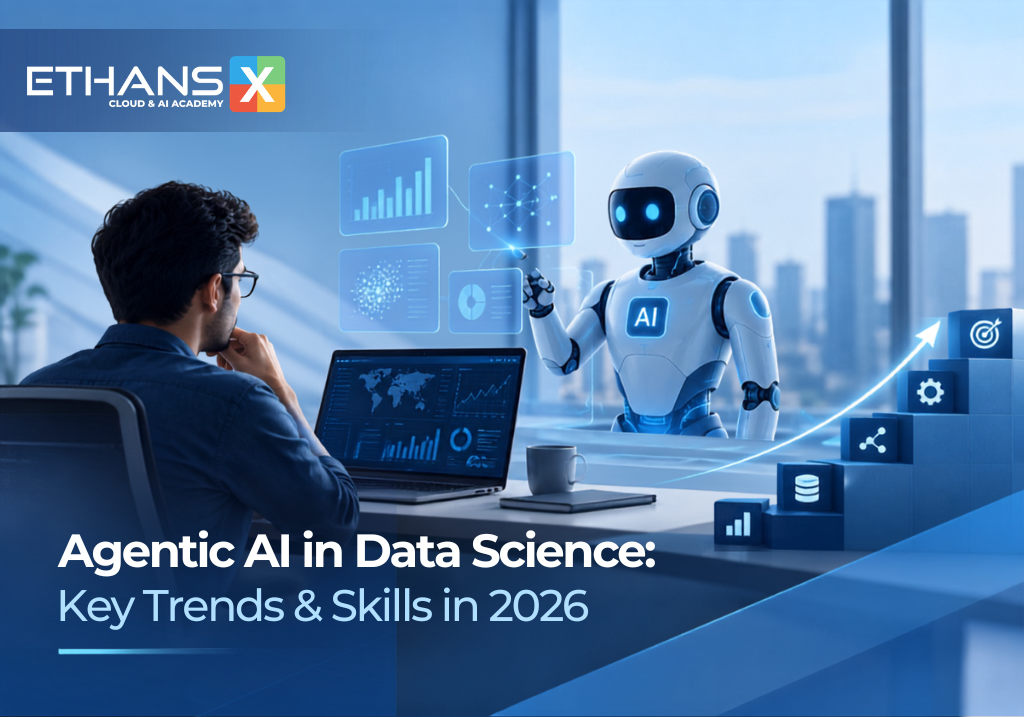
Imagine a data scientist in 2022. They would spend 80% of their time finding the right datasets, writing code, running analysis, building visualizations, and explaining the findings. Most of the work was manual, taking days to complete work on a dataset and derive value from it.
Cut to present. In 2026, AI is increasingly automating or assisting with many repetitive data science tasks. But what’s even more important is that it is also helping data scientists decide what to do next! You must be wondering what’s driving this shift in intelligence. The answer is agentic AI.
Traditional AI systems respond to a specific prompt to perform a particular task. Agentic AI can plan multi-step actions, use tools, evaluate intermediate results, and continue working towards a specific objective. But leveraging agentic AI appropriately and effectively is a skill data scientists must develop.
If you are an aspiring one looking to pursue a data science course in Pune, here are the key trends and skills you must know.
What is Agentic AI and its Impact on Data Science?
To understand why agentic AI matters for data science professionals, we must first explore agentic AI vs. traditional AI in data analytics.
Traditional AI and Standard Generative Models: Smart, yet these models are fundamentally reactive. They need prompts to generate an outcome, whether text, image, or code. Later, if the code breaks, you must copy and paste the error back into the prompt.
Agentic AI: Agentic AI is smarter. It is autonomous, goal-driven, and action-oriented as its systems are designed to pursue goals through multiple steps, using tools, feedback and predefined constraints.
For instance, if you ask agentic AI to find the root cause of employee attrition in Q4 2025, it will distribute the goal into sub-tasks, queries, vendor databases, and run exploratory Python scripts. Additionally, it checks its work, corrects execution errors, and synthesizes final strategic insights.
Thus, the role of autonomous AI agents in data analytics is enhancing the role of data scientists. The technology is helping data scientists move from working as code executors to system orchestrators.
How is Agentic AI Changing Data Science Workflows in 2026?
Multi-agent systems have restructured the lifecycle of standard analytics. Let’s compare traditional workflow and agentic AI workflow transportation.
| Traditional Workflow Stage | Agentic AI Workflow Transformation (What AI Agents Do?) |
| Data Preprocessing and Cleaning | Auto-detect missing values, handle outliers, and perform schema validation with synthetic data fallback. |
| Exploratory Analysis (EDA) | Generate statistical summaries, auto-plot feature distributions, and highlight non-intuitive correlation anomalies instantly. |
| Feature Engineering and Modeling | Iterate through feature selection hypotheses, leverage AutoML pipelines, while tuning hyperparameters continuously. |
| Deployment and Monitoring | Monitor drift, trigger retraining cycles, and maintain MLOps pipelines in production. |
The Skills Gap: Best Data Science Skills for the Agentic AI Era
A comprehensive data scientist course in Pune that covers agentic AI prepares you for the future of data science. It bridges the skill gap between AI-driven data science and traditional data science by developing technical competencies that include the following.
- Core Agentic Frameworks and Multi-Agent Orchestration: Mastering LangChain, LangGraph, CrewAI, and AutoGen.
- Advanced Retrieval-Augmented Generation (RAG) and Vector Databases: Understanding how to connect LLMs to proprietary enterprise data stores with vector databases (Chroma, Pinecone) and graph search techniques to provide contextual domain knowledge to agents.
- Human-in-the-Loop Governance and AI Safety: Establishing deterministic guardrails, implementing policy-aware monitoring, and building human-in-the-loop validation checkpoints to ensure enterprise governance as agents gain operational autonomy.
- System Architecture and API Integration: Understanding system architecture, tool-calling patterns, and robust API handling as agents act on the physical or digital world by calling REST APIs, executing SQL queries, and manipulating software tools.
Some other skills also include:
- Statistical and Analytical Thinking: AI can identify correlations. However, humans must be able to question whether those relationships are meaningful from the business and statistical viewpoint.
- Python and SQL: AI can generate code. But data scientists must be able to understand, examine, and modify it as required.
- Agent Orchestration: Data scientists must also understand how agents plan tasks, interact with tools, and operate within defined constraints.
- Machine Learning: It is also important to understand models, evaluation metrics, feature engineering, and model limitations.
How Pune Professionals Can Future-Proof Their Data Science Careers
Learning the above skills is crucial while pursuing data science training in Pune. However, learning them in isolation won’t help. You need a course that connects these foundational elements with LLMs, GenAI, agentic workflows, data engineering, cloud platforms, and real-world projects.
Essentially, the data science classes in Pune you choose must train you on working with AI instead of merely treating it as a theoretical subject.
Along with data science, joining agentic AI classes in Pune, particularly those focusing on practical implementation instead of just concepts, can help you stay relevant and secure your career in data science.
Ready to Become an AI-Driven Data Scientist?
Agentic AI is helping data science and data scientists emerge from traditional workflows and limitations. It isn’t rendering data scientists redundant but promoting them to a role where they can better utilize their skills and intelligence. But such a transition is possible only when you join the right data science course in Pune. Ethans Tech provides such a course.
Our data scientist course in Pune involves understanding agentic AI essentials and working with them to work faster with data, drive better outcomes, and deliver more meaningful value. Besides, our seasoned trainers, practical exposure, and placement assistance work toward helping you confidently launch or upgrade your career in data science.
Call us at +91 95133 92223 to connect with our experts and explore more details about our course, upcoming batches, fees, and placement assistance.
Frequently Asked Questions
How are Pune companies adopting agentic AI for analytics?
For instance, manufacturing analytics teams are using multi-agent systems to monitor IoT telemetry streams across assembly lines, predicting component wear and autonomously scheduling preventive maintenance.
On the other hand, financial institutions are deploying compliance and fraud-detection agents that pull transaction logs, cross-reference anti-money-laundering (AML) rules, and stop anomalous operations in sub-seconds.
How large language models are changing data science education in Pune
Data science courses in Pune are shifting from traditional coding-focused learning toward AI-assisted problem-solving. As a result, aspirants are expected to master using LLMs for code generation, SQL queries, data exploration, documentation, and insight generation.
What are some real-world use cases of agentic AI in analytics?
Agentic AI can autonomously monitor sales trends, detect anomalies, investigate customer churn, forecast demand, analyze marketing performance, and generate reports. For example, it can identify a drop in sales, analyze the underlying data, determine possible causes, and make recommendations.