Skip to content
Whether it is Mira Maruti’s latest innovation, Inkling (an open-weight AI model), or the massive, infamous Oracle layoff that happened earlier this year (behind which, AI was one of the reasons), AI is in the news for every possible reason you can think of.
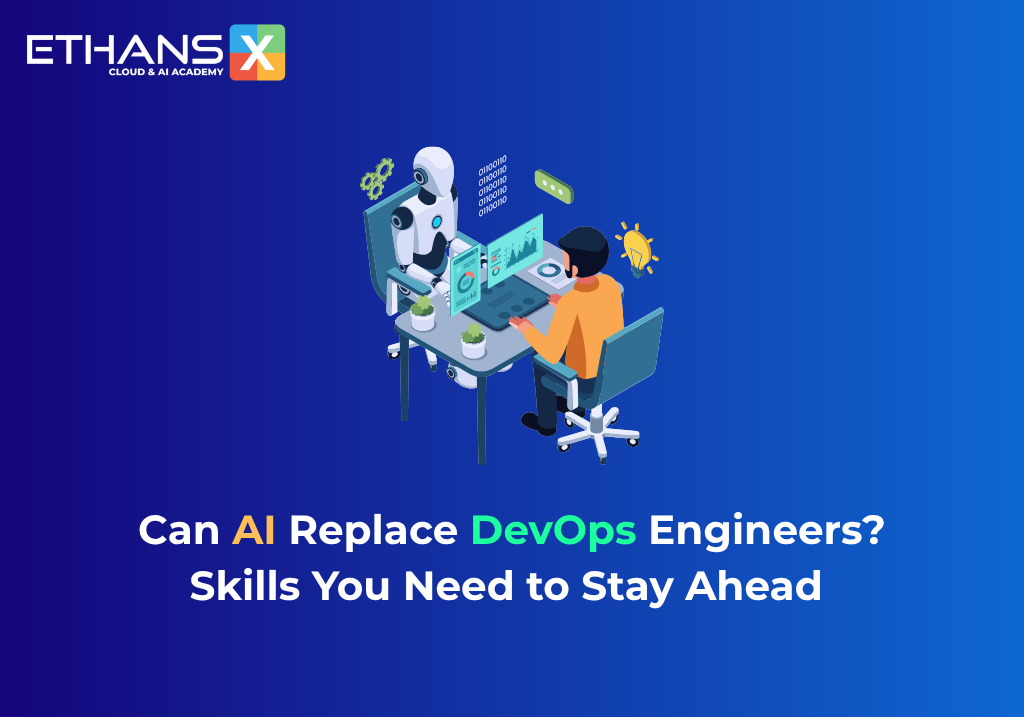
While everyone admires AI innovations, the one thing that apprehends everyone, including DevOps engineers, is AI replacing them.
AI transforms software development, testing, deployment, and monitoring. What once took days or weeks can now be completed within hours with AI-powered automation. But then, will AI render DevOps engineers redundant?
If you are an existing DevOps professional or a freshie looking to enroll in DevOps classes in Pune, you must be wondering, ” Is DevOps a good career after AI?” So, here’s a blog that addresses your apprehension.
Can AI Replace DevOps Engineers Completely?
The answer is a resounding NO. AI will not replace DevOps engineers fully. However, it will surely redefine a DevOps engineer’s role by automating several routine tasks, including the following.
- Writing infrastructure-as-code templates
- Generating CI/CD pipeline scripts
- Monitoring system logs
- Detecting anomalies
- Predicting failures
- Creating documentation
- Suggesting remediation steps
Nevertheless, DevOps goes beyond automation. DevOps engineers collaborate with multiple teams, including development, security, testing, and operations. They design scalable architecture, resolve production concerns, optimize cloud costs, enforce governance, and make business decisions.
AI can automate activities, but cannot handle tasks where critical thinking, contextual decision-making, or human intelligence is required.
For instance, AI cannot negotiate priorities. Only a DevOps engineer can do it. It cannot understand business objectives. But a DevOps professional does.
Therefore, instead of replacing DevOps engineers, AI will emerge as a powerful, relentless assistant that helps them enhance their work.
As a result, DevOps engineers can focus on:
- Cloud architecture
- Reliability engineering
- Automation strategy
- Security
- Cost optimization
- Performance tuning
- Cross-functional collaboration
As an aspiring or existing DevOps professional, it all depends on how you look at AI. The right approach is to learn how to work with AI rather than compete against it.
Is DevOps Still in Demand After AI?
Yes. AI is increasing the need for skilled, AI-ready DevOps professionals who will play a crucial role across various major areas. For instance, companies will need DevOps engineers for reliable infrastructure, automated deployments, monitoring compliance, and security. Each of these areas is critical to run AI-powered applications safely and optimally.
Therefore, the answer to the question, ” Will AI reduce DevOps job opportunities?” is no. Businesses are actively hiring professionals with expertise in DevOps and AI-enabled workflows. No wonder several institutes offering DevOps training in Pune Kharadi and many other localities across the city are now integrating GenAI and AI-assisted DevOps into their syllabus.
What Skills Should DevOps Engineers Learn in 2026?
It is clear that AI will not replace DevOps engineers. However, the technology and its usage will only grow. So, how can DevOps professionals stay relevant in the AI era? It is by choosing a comprehensive DevOps course in Pune that helps you develop skills that include the following.
AI-Assisted Infrastructure Automation
Instead of manually writing repetitive code, engineers must learn how to validate, customize, and optimize AI-generated infrastructure. It is because AI tools can now generate Terraform templates, Docker configurations, and deployment scripts.
Cloud Computing Expertise
Since cloud platforms are the backbone of modern DevOps, engineers must focus on developing AWS, Azure or Google Cloud Platform skills. A professional program in AWS cloud and DevOps that covers cloud architecture, CI/CD, containerization, security, and AI-powered automation can help you acquire the latest skills within this domain.
Kubernetes and Container Orchestration
AI applications deploy containers. Hence, you must master Kubernetes, Docker, Helm, Amazon EKS, and Azure Kubernetes Service. Container orchestration is a high-value DevOps skill in the modern world.
CI/CD Pipeline Integration
AI can generate pipelines. However, companies still need engineers to ensure they are secure, reliable, scalable, and cost-efficient. Accordingly, you must understand GitHub Actions, GitLab CI/CD, Jenkins, and AWS CodePipeline.
AI Tools for DevOps
With so many tools around, many learners wonder what AI tools should DevOps engineers learn. Some of them include GitHub Copilot, Google Gemini, Amazon Q Developer, Datadog AI, Dynatrace Davis AI, OpenAI ChatGPT, Harness AI, New Relic AI, and PagerDuty AI. Learning these platforms helps you automate coding, troubleshooting, monitoring, documentation, incident response, and root cause analysis.
DevSecOps and Cloud Security
You cannot fully rely on AI-generated content, particularly in terms of security. Validating security still requires human expertise.
Therefore, to become a future-ready DevOps engineer, you must master IAM, Zero Trust principles, secrets management, container security, compliance automation, and vulnerability scanning.
Observability and Monitoring
While AI identifies anomalies, humans interpret business impact. Therefore, learning platforms such as Splunk, Grafana, Prometheus, ELK Stack, and OpenTelemetry can prove to be helpful.
Is Learning DevOps Worth it in 2026?
Yes. It is. AI inclusion itself isn’t a threat to a DevOps engineer’s job. However, not learning AI can put your career at risk.
At Ethans Tech, we understand this simple yet critical fact.
Therefore, we provide a comprehensive DevOps course with placement in Pune that covers everything from the latest syllabus to job assistance.
We don’t just train you in DevOps and AI. We also prepare you for AI-powered DevOps career opportunities, including Platform Engineer, DevSecOps Engineer, Site Reliability Engineer (SRE), MLOps Engineer, AI Infrastructure Engineer, Cloud Solutions Architect, and many others.
So, call us at +91 95133 92223 and explore more about our DevOps course in Pune, its curriculum, career roadmap, and placement opportunities.
Frequently Asked Questions
What skills are needed to become an AI-ready DevOps engineer?
Expertise in Kubernetes, Infrastructure as a Code (IaaC), CI/CD, observability, DevSecOps, AI-powered automation tools, and cloud platforms can help you become an AI-ready DevOps engineer.
How Does AI Affect DevOps Careers?
AI impacts DevOps careers by changing responsibilities and helping engineers to focus on more complex tasks, such as reliability engineering, performing tuning, security, and cross-functional collaboration.
Can Generative AI Automate DevOps Tasks?
Yes, it can. But partially. Generative AI can create YAML files, generate deployment scripts, draft documentation, produce IaaC templates, and recommend performance improvements.