...

Python Course for Non-IT Background: Can You Become a Developer?

Python Course for Non-IT Background

Are you an aspiring developer but without an IT background? Lately, you’ve seen your friends switch to tech jobs, work on exciting projects, and earn competitive salaries. And now, you wonder whether you can also join IT as a developer without a technical background. A decade ago, or a little earlier, when development was exclusively the domain of coding experts, this thought might have sounded irrelevant. But today that barrier has vanished. So, the simple answer to your question, whether you can become a Python developer without an IT background, is – yes! You can make this transition with a comprehensive Python course in Pune.  Here’s a blog that explains how you can become a Python developer without a technical background, while exploring many other aspects of a career as a Python developer. What is Python Programming? Before exploring whether Python for a non-IT background candidate is feasible or not, let us understand what Python programming is. Python is a high-level programming language prized for its simple syntax and readability. It has a gentler learning curve than other languages, making it possible for even beginners with no coding experience to become Python developers.  Python is a versatile language widely used across web development, data analysis, data science, AI, ML, automation, scripting, and software development. Hence, many global giants such as Google, Meta, Netflix, Amazon, Uber, PayPal, etc., use Python for various tasks such as backend development, ML, and automation. Therefore, it is a top choice for non-IT professionals looking to enter the global tech industry. Many of them enroll in Python certification courses that prepare them for the global race. Can Non-IT Students Become Python Programmers? Is learning Python feasible for someone from a non-IT background feasible? As stated earlier, the answer is yes. Thousands of professionals prove this feasibility every year. Graduates from different streams, such as commerce, civil engineering, mechanical engineering, arts, humanities, and even business administration, enroll in Python classes in Pune. With consistent practice, exposure to real-world projects, hands-on experience with industry tools, and a guidance from a reputable Python training institute, you can become a successful Python programmer.  Is Python Suitable for Beginners? Yes, it is. Python is designed with beginners in mind. Hence, most newcomers begin their journey with it by pursuing a Python course for beginners.  Some reasons that make it ideal for novices include the following. Wide Career Applications: Certified Python skills can help you land roles such as development, data science, automation, and analytics. Simple Syntax: Python reads almost like plain English. Hence, understanding it is simpler than languages such as C++ or Java. Huge Learning Community: The language has a massive learning community where millions of learners and developers share tutorials, forums, and resources. Python Learning Path for Beginners You can become a Python developer without an IT background. However, you need structured Python classes with hands-on training to help you accomplish your goal. A standard Python certification course usually includes the following learning stages. The best and most comprehensive Python course in Pune combines theory with hands-on training, which helps you build practical skills and experience. Read Blog : ” Python for Data Analytics: Why It is a Must-Learn Skill? “ Career Scope After Python Course Now, the next thing you must be wondering about is job opportunities after the Python course in Pune with placement support. After a Python certification course, graduates usually qualify for roles such as: Usually, a Python developer’s career path begins with entry-level Python developer roles and then moves to senior positions. Many companies offer Python jobs for non-IT background candidates with solid practical skills and project experience. Best Python Course for Non-IT Background While moving to a Python-based IT job, you must choose the best Python course for a non-IT background. The course you select must have a beginner-friendly curriculum, provide exposure to hands-on projects and industry tools and frameworks. It must also award a globally-recognized certification, and render 100% placement assistance.  Python Course Duration, Fees & Certification Python course duration depends on the program you choose. Beginner courses usually last 2-3 months, while advanced or career-focused programs may extend up to six months. Many institutes offer classroom-based Python classes in Pune. But if you cannot travel to Pune, you may also join online Python training in Pune. Now, in some cases, choosing between online and classroom can be challenging. So, here is a brief Python course online vs classroom comparison. Benefits of Online Python Training Therefore, an online course is suited to working professionals and remote learners. Benefits of a Classroom Python Course in Pune Hence, classroom courses are suitable for beginners who need a more systematic, structured guidance to begin their Python journey. Python Developer Salary in India The salary earned by Python developers in India encourages many professionals to enter the IT industry. The average Python developer salary in India is usually from ₹3 LPA – ₹6 LPA* for freshers, ₹6 LPA – ₹12 LPA* for mid-level professionals, and ₹15 LPA+* for experienced developers. Your growth as a Python developer will significantly depend on practical skills, project experience, certifications, and continuous learning. Note: Salary ranges are approximate and can vary based on the location, employer, practical skills, experience and many other factors. Gear Up for a Promising Career with a Python Course with Ethan’s Tech! Programming is no longer the monopoly of IT graduates. With a structured Python course, even non-IT students can join IT as Python developers.  On the other hand, many companies are also supporting this change by providing Python programming jobs for freshers.  So, now that you know you can become a Python developer even if you are from a non-IT background, you must choose the right training institute.  With over a decade of experience transforming careers, Ethans Tech provides the right Python course in Pune with a comprehensive course curriculum, structured learning, extensive practical exposure, and 100% placement support. These factors make us a preferred Python institute in Pune, among both IT and non-IT professionals. … Read more
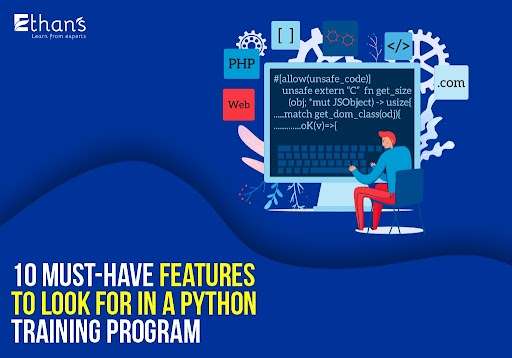
10 Must-Have Features to Look for in a Python Training Program

Look for in a Python Training Program

Do you aspire to become a Python professional and want the right Python course in Pune to kickstart your career? Your urge to choose the best is appreciable!  However, choosing what’s right for your career involves a considerable effort in evaluating different Python courses across various parameters. So, let’s get straight to the point and look at ten features you must look for in classroom or online Python training in Pune. 10 Factors to Consider While Choosing a Python Course in Pune Amidst Pune’s competitive environment, qualifications and the type of course you pursue matter! Python training isn’t an exception.  Thus, you must ensure you make the best possible choice that grooms you as a Python professional and unlocks career opportunities. Here are ten essential aspects to assess a Python course on. Course Content and Syllabus The course content should cover essential topics like the basic and advanced aspects of Python alongside other technologies like data science, automation, web development, etc. The curriculum should also focus on the practical application of each technology, enabling you to work in the industry more confidently. Library Exposure Library exposure refers to the numerous libraries Python offers. These include NumPy, Pandas, Django/Flask, Git, Jupyter Notebook, etc. Exposure to these libraries will help you use Python better and transform you into a more learned Python professional. Mode of Learning Although classroom courses have returned post-COVID, the course should also offer online learning to enable distant students or working professionals to learn conveniently. Some institutes also offer blended learning, allowing students to learn in both environments and interact with faculty members in person.  Faculty Expertise Faculty expertise and experience prove key while pursuing Python classes in Pune. Learning under seasoned specialists helps you learn from their experiences and enhance your value as a Python expert. Practical Experience The course must emphasize practical learning and provide abundant practical exposure to help you use Python technologies efficiently. The institute you choose should provide you the opportunity to work on tools and technologies to help you get first-hand experience of the industry. Value of Certification The Python course should be recognized in the industry and by its experts. Furthermore, the certification must have value from the viewpoint of employability. Batch Size Look for courses with a limited batch size. Trying to coop more and more students in a cluttered space affects the learning experience. In such situations, it becomes challenging for faculty members to pay individualized attention to every student. A limited batch size simplifies learning and focuses on every student.  Alumni Feedback Past-student feedback matters a lot. Hence, you must insist on reviewing it before you finalize your choice. It will help you learn how the course has helped its students and how they are faring in the market. Overall, it will help you make informed decisions.  Internship Opportunities Working as an intern helps you gain basic industry knowledge and experience. It prepares you for industry challenges and lets you step out as a more knowledgeable professional. Besides, in many cases, internships pave the way to employment.  So, if you perform well, you might as well have a job before you finish the course. Thus, a course with internship opportunities should be preferable. Placement Support Whether you pursue a Python course in Pune or any other, everything boils down to two things – the technical expertise you build and the course’s placement. Accordingly, you must choose a Python course with placement across various reputed organizations in different domains where Python is used. Such a course can provide a solid head start to your career! Embrace a Broader Python Career Spectrum with Ethan’s Python Classes in Pune Ethan’s Tech is your passport to a thriving career in Python. We provide Python courses that ensure comprehensive technical education, professional grooming, practical exposure, experienced faculty members, and yes, placements! So, if you are considering a career in Python, you need a course offered by an institute like Ethan’s Tech. Explore our Python course in Pune and call us at +91 95133 92223 to learn more about other details like Python course fees in Pune, batch timings, etc.

Python Programming Scope in Future

Python programming

In the ever-evolving landscape of technology, certain skills stand out as indispensable assets for professionals seeking a successful career trajectory. Among these, Python programming shines as a beacon of opportunity, offering a multitude of advantages and a promising future. As we delve into the scope of Python programming in the years ahead, it becomes evident that its relevance and demand are only poised to grow. 1. Ubiquity Across Industries Python’s versatility and ease of use have led to its widespread adoption across diverse industries, including but not limited to software development, data science, artificial intelligence, web development, scientific computing, finance, cybersecurity, and education. Its extensive library ecosystem, encompassing frameworks such as Django, Flask, TensorFlow, Pandas, NumPy, and Scikit-learn, empowers developers and data scientists to tackle a wide array of challenges efficiently. 2. Dominance in Data Science and Machine Learning In the realm of data science and machine learning, Python has emerged as the de facto language of choice. Its intuitive syntax, coupled with powerful libraries like Pandas, NumPy, Matplotlib, and Scikit-learn, streamlines the process of data analysis, visualization, and model development. As organizations increasingly harness the power of data-driven insights, the demand for Python-proficient professionals in data science and machine learning roles continues to soar. 3. Growth in Web Development Python’s web development frameworks, such as Django and Flask, facilitate the rapid creation of robust and scalable web applications. With Django’s emphasis on simplicity and flexibility, coupled with Flask’s minimalist approach, Python empowers developers to build dynamic web solutions with ease. As the demand for web applications surges in tandem with the digital transformation of businesses, Python’s role in web development is poised to expand further. 4. Expansion in Artificial Intelligence and Automation Python’s role in artificial intelligence (AI) and automation is burgeoning, driven by its extensive support for AI libraries and frameworks. From natural language processing (NLP) with NLTK and spaCy to deep learning with TensorFlow and PyTorch, Python provides the building blocks for developing sophisticated AI solutions. As industries increasingly embrace automation to enhance efficiency and innovation, Python’s prominence in AI and automation is set to grow exponentially. 5. Accessibility and Community Support One of Python’s greatest strengths lies in its accessibility to beginners and seasoned professionals alike. Its clear and concise syntax, coupled with comprehensive documentation and a vibrant online community, lowers the barriers to entry for aspiring programmers. The wealth of tutorials, forums, and open-source contributions fosters a collaborative environment where knowledge sharing thrives, further cementing Python’s position as a go-to language for developers worldwide. 6. Integration in Education and Research Python’s simplicity and readability make it an ideal choice for educational institutions and research organizations seeking to introduce programming concepts and conduct experiments. Its versatility extends to fields such as computational biology, astronomy, physics, and social sciences, where Python serves as a bridge between domain expertise and computational analysis. As academia continues to embrace Python as a tool for innovation and discovery, its role in education and research will only strengthen. 7. Adaptability to Emerging Technologies As emerging technologies such as blockchain, quantum computing, and the Internet of Things (IoT) gain traction, Python’s adaptability ensures its relevance across a spectrum of cutting-edge domains. Whether it’s developing smart contracts on blockchain platforms, orchestrating IoT devices with Micro Python, or exploring quantum algorithms with Qiskit, Python empowers developers to explore the frontiers of technology and drive innovation forward. Final Thought In conclusion, the scope of Python programming in the future is exceptionally bright, driven by its versatility, simplicity, and robust ecosystem. As industries continue to embrace digital transformation and innovation, Python’s role as a foundational technology will only strengthen, opening doors to diverse career opportunities and exciting possibilities in the years to come. For aspiring professionals and seasoned veterans alike, mastering Python programming is not just a choice—it’s a strategic investment in a future-proof skill set poised for enduring relevance and success.

How Long Does It Take to Learn Python?

How Long Does It Take to Learn Python?

What is Python? Before delving deeper into the blog, let us first see what Python is? Python is a programming language that is interpreted, object-oriented, and turns out to be a high-level language that consists of dynamic semantics. Its high-level logic that is developed in data structures in combination with dynamic binding and dynamic typing makes it highly attractive for all kinds of Rapid Application Development. Python is also used as the glue or scripting language in order to connect the already existing components together. For your information, Python is easy to learn as it is simple to comprehend the syntaxes. It emphasizes strict readability and ergo, it reduces the incurred cost of the program and its maintenance. Python supports packages and modules, which in turn, encourages code reusability and program modularity. The Python interpreter and its wide-ranging standard library are available throughout in the source or binary form without any kind of charge for all types of major platforms, and hence, it can be freely distributed. Why Learn Python in 2021? Python is getting popular day-by-day and hundreds of thousands of students, as well as working professionals, are trying to enrol themselves in a reputed college, institution, or university so that they can learn Python and make their career recession-proof and future secure. Python has more job opportunities than ever and myriads of top-notch MNCs and organizations are looking for professionals who are great in Python. Did you know – according to the Stack Overflow survey, Python is one of the most loved programming languages of 2020? So, in short, if you have Python mentioned in your updated resume, then your chances of selection in an interview will increase drastically as compared to the person who has never even heard of Python in their life. Python training in 2021 is a must if you want to survive in this competitive market and want to work in your dream organization. Here are the top 5 reasons why you should learn python: 1. Python is Simple to Learn One of the sweetest things about Python is that it is very simple to learn. If you ask the majority of today’s programmers that which programming language is the easiest to learn – more than 90% of them will mention Python. Even a person who has no idea about coding and programming can learn the basics of Python in a few days of practice. 2. It Has Fewer Lines of Code Python has fewer lines of coding than other languages such as C, C+, and Java. In the case of Python, simplicity is the key and it is this concept that lets you do more with Python than any other language. You can save a lot of time with Python! For example, to print “Hello World” in Python you just have to write a single line of code whereas in the case of Java you will need to write at least 4 lines of code. 3. A Stepping Stone to Learning Other Programs A cool fact about Python is that it can serve as a stepping-stone for all the developers who are new to the world of coding. Python’s highly object-oriented principles are 100% compatible with all other programming languages such as – JavaScript, Ruby, Perl, and C#. So, in short, once you’ve mastered the real concepts of Python, other coding languages would seem easier to you and the syntax will come naturally to you. 4. Perfect For Building Prototypes Python is always considered ideal for building prototypes. It is the true fact that Python always lets you do more with less code also helps you build the simplest ideas and prototypes quickly. In a programming language, ideation is most of the time an often-overlooked aspect but in the case of Python, one can easily come up with the theories of functioning prototypes quickly and it can help you solve complex problems in lesser time. It can also help you save money and satisfy the needs of clients more effectively. 5. Tons of Resources at Your Disposal If you’re a Python developer then it would not be boasting to say that it’s practically impossible for you to get stuck in complexity with a large number of resources always available and keeps getting refreshed constantly. It also supports an extensive library that possesses built-in functionality that has the ability to explain why so many of the programming languages are written in Python. Another amazing fact about Python is that it also has a built-in unit-test framework that ensures your written code always works as you intended. How Should I Approach Learning Python? Approaching to learn Python is quite simpler than other programming languages. Write a few lines of code every day and try to interact with mentors or seniors who have prior experience with Python. If you have any doubts about Python then you must resolve them by asking questions to senior programmers. Join Python-related communities and groups on social media to find real-time answers as most of them have lots of active members. In short, surround yourselves with people who are either proficient in Python or are a learner just like you. When you have indulged yourself in Python then a time will come that you will see “Bugs” in your program but don’t let that disappoint or demotivate you; even the best of the best coders have bugs in their code but what makes them great developers or coders is that they find those bugs and utilizes a methodological approach to solve them. Last, but not least, you can use the concept of paired programming. Pair programming is a highly advantageous technique that involves exactly two developers who are working at a single workstation to complete a given task. These two developers sometimes switch between being the “navigator” and the “driver.” The “driver” always writes the code, while a “navigator” assists or guides the “driver” in problem-solving techniques. They also review the written code and always switch frequently or several times unless … Read more

100% Job Assistance Certification Programs

Learn from Industry Experts & IIT Mentors

6+ LPA

Avg Salary

12+ LPA

Highest Salary

53k+

Students Trained